
Your Boss Texted You on Your Day Off. What Do You Send Back?
By Sonam Patel · · 7 min read
Your boss texts you on your day off. Do you reply, wait until tomorrow, or politely say you are unavailable? Here's what to send in each situation.
What happened
On Weekend Edition Saturday, NPR ran a profile of George Stern, a leadership coach and former CEO who posts anonymous screenshots of messages managers send their staff. The segment aired a few of them.
An employee contacted on their wedding day. A vacation approval rescinded. And a bereavement thread that starts with "My grandmother passed away last night. I'll be taking bereavement leave this week. At the airport now," and gets the reply "When you say the week, a funeral's only one day, though, right?" The manager then asks for proof, questions whether a grandmother counts as immediate family, and asks whether the employee could dial into a pitch from Ohio.
Stern said he has yet to post a video that did not draw dozens of replies saying the same thing had happened to them.
That last line is the story. Not that one manager was awful, but that a great many people recognized the exchange and had no idea what to send back.
Why the reply is hard
Three things are competing in the ten seconds before you type.
Timing. The point of a day off is that you are off. Answering in four minutes teaches everyone that you are reachable in four minutes.
Tone. The reply has to be warm enough that it does not read as a snub, and short enough that it does not invite a conversation. It is easy to start with an apology, even when you have not done anything wrong. You can be polite without apologizing for taking your day off.
Record. Whatever you write goes into a thread that will exist after the project is done, and may be read by someone who was not in the room.
The reason this feels impossible is that you are trying to answer a question about work while also answering a question about the arrangement. The message you send is the second answer, whether you mean it to be or not.
When it really is an emergency
Some of these messages are legitimate. A server is down, a client is flying in, something is due that only you can find. Pretending otherwise is how people end up writing a careful boundary message at the worst possible moment.
Answer, then name the day.
"I'm off today, but I understand this is urgent. I can give you a quick call in about ten minutes."
The middle sentence is doing the work. It takes the urgency seriously without treating today as a normal working day.
If you can answer in one line, do that and stop.
"The file is in the shared drive under Q4 final. That should unblock it."
When it can wait
Most requests fall here, and most people answer them anyway. The trick is to reply without working.
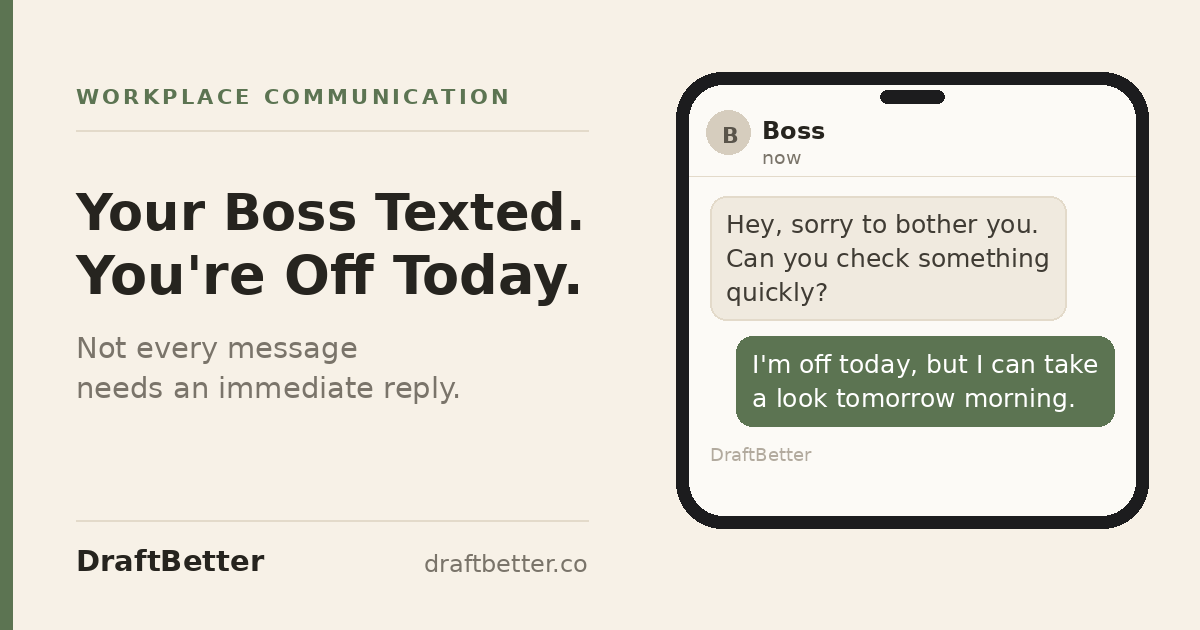
"I'm off today, but I can take a look tomorrow morning."
That is the whole message. No apology, no reason, no offer to check it on your phone.
If you want to be more helpful than that:
"Just saw your message. I'm off today, but I'll check this first thing tomorrow morning."
Notice what it does not do. It does not invite your manager to argue that the request is urgent after all, which is what an offer to call always turns into.
When you want to say no
You are allowed to say no without a reason. It is also usually easier to send if you have one.
"I'm not available today. I can pick this up tomorrow."
If they press:
"I understand it is time sensitive. I am still not available today. Tomorrow morning is the earliest I can do."
Repeat the same sentence rather than building a second argument. A no that keeps changing shape reads as negotiable.
How to set boundaries without over-explaining is the longer version, and how to say no professionally in an email covers the written version for a manager who prefers email.
When it keeps happening
One message is a misunderstanding. A pattern is an arrangement somebody set, and it is worth naming.
"Could we talk about the out of hours messages? I want to be reachable when something is truly urgent. At the moment it is most evenings, and I am not able to keep doing that."
Say it on a call or in person, not in the thread. Written, it reads as a complaint about a specific message. Spoken, it reads as a request about a system.
Two things help before you send it. Agree what counts as urgent, so the category is not being invented at nine at night. And ask whether there is an on-call expectation you have missed, because sometimes there is, and nobody told you.
How to have a difficult conversation at work covers the meeting version of this, if a text feels like the wrong channel.
When you are on approved leave
This is the case with the most riding on it, because leave has usually been approved in writing and someone is now behaving as though it has not.
"I'm on leave until the 12th. I'm not checking messages, but I will pick this up when I'm back."
Two details. Name the return date, so there is nothing to ask a follow up about. And say plainly that you are not checking, rather than implying it. "I might not see this" invites them to keep trying.
If the request really is time critical, offer one narrow exception and put a fence around it.
"I'm on leave, but I can send the handover document this evening. After that I am offline until the 12th."
If you are on bereavement leave specifically, the segment's exchange is the one to remember. You should not have to defend your grief in a text conversation. If your workplace requires documentation for bereavement leave, that can be handled separately through the normal process. A single sentence covers the reply.
"I'm on bereavement leave until Friday. I'll be back on Monday and will pick everything up then."
When you are happy to help
There is a version of this where you do not mind at all, and it is worth knowing how to say that without setting a precedent you will resent in three months.
"Happy to look at this tonight. Just so we are on the same page, I'm generally offline on Sundays, and today is the exception."
That is not coldness. It is the difference between a favor and an expectation, and it usually lands fine.
What not to send
"Sorry for the slow reply." You were not slow. You were off. The apology confirms the message was reasonable.
"I'll take a look." Written on a day off, this means "I am working today." If you are not going to look, do not say you will.
"This could have waited until Monday." True, and it turns a scheduling question into a verdict about their judgment. Save it for the conversation about the pattern, where it has somewhere to go.
A funny line about the request. In the NPR segment the employee wrote "Deaths are famously inconsiderate about pitch schedules," which is a good line and probably got a laugh. It also made the exchange about attitude. If you want the last word, get it from a friend, not from the thread your manager has a copy of.
Replying to prove a point. If your role includes emergency or on-call duties, follow the agreed process rather than improvising one in a text. If it does not, you are not obliged to turn every message into a conversation.
Where to leave it
The reply is not the boundary. The reply is what you do about the boundary today, and the pattern is what you deal with later.
Say the day. Say the return time. Give them nothing to negotiate with, and stay warm enough that the next message is ordinary.
DraftBetter helps you find the words for the message you are putting off, and explore how it might come across before you send it. Start your message.
Ready to say it?
Describe your situation and DraftBetter will write the message, then show you how the other person is likely to read it.