
Your Neighbor Won't Turn It Down. What Do You Write on the Note?
By Sonam Patel · · 8 min read
An apartment resident drafted a note about noise from upstairs and asked Reddit to check it before delivering it. Most of the replies were about the wording, not the noise. What to write instead, and what to do if a note is ignored.
What happened
An apartment resident drafted a note for the people upstairs and posted it to r/Apartmentliving to ask whether it was polite enough to deliver. Their footsteps, the note said, rattled the lights and scared the pets. It opened with "Hello! We hate to be those neighbors," explained that the building is not well insulated, and asked whether they could avoid running and stomping, especially late at night.
The replies were mostly about the writing, not the noise. "You're using some very aggressive language in this note," one person said. Others pointed at the word "obviously," which reads as condescending. Several objected to the line drawn between normal walking and running. As one commenter put it, the neighbors are probably walking normally for them, it sounds loud from below, and there is not much they can do about that in a note. Someone else noticed the note was written on a pad printed with "WOOF," in a household with a dog.
The original poster read the thread and decided not to send it. "I appreciate you all bringing me back down to earth," they wrote.
That is the useful part of this story. A complaint that was reasonable in substance came back from the thread almost entirely about its wording. The note was never delivered, so no conflict happened, but the feedback showed how easily a fair request turns into an argument about how it was phrased.
Why these notes go wrong
A noise note has one job: to start a conversation about a specific thing at a specific time. Much of what people add to it works against that.
The diagnosis. "Your footsteps are jarring." You cannot know what the other person is doing up there. They may be walking normally on a floor that carries sound, in which case you have just accused them of something they are not doing. One commenter in that thread made the sharper version of this point: if the floorboards are the problem, another note will not fix it. Either way, the complaint becomes about whether they are a stomper, and the noise stops being the subject.
The generalization. "All night, every night." If it happens three times a week, say three times a week. An exaggerated frequency is the easiest thing in the note to disprove, and once one claim is wrong the reader discounts the rest.
The audience. "From all your neighbors." Speaking for people who did not ask you to is how a private annoyance becomes a public one. It also reads as a threat, which is the opposite of what you want from someone you have to see in the hallway.
The moral. "Some of us have to work in the morning." True, and it invites a reply about the other person's shift pattern. Detail beats principle. Times and dates are harder to argue with than a claim about consideration.
The note that works
Four parts, in this order. What happened, when it happened, what you are asking for, and one line that leaves the relationship intact.
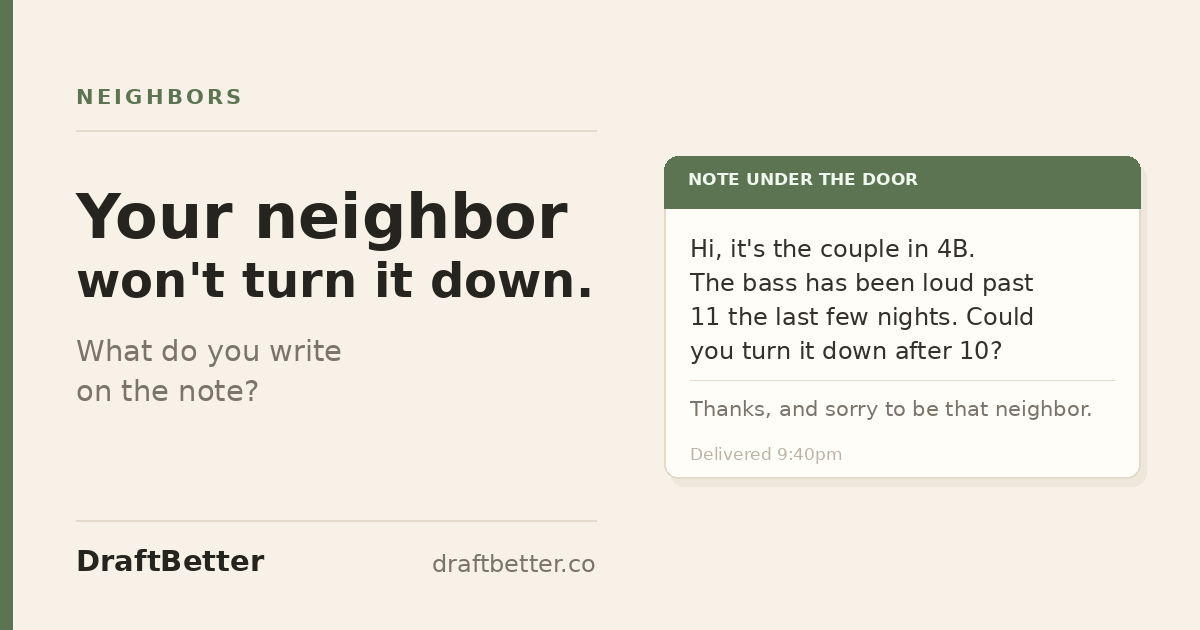
"Hi, this is the apartment below you. The bass has been loud past 11 the last few nights, and it comes through the floor. Could you turn it down after 10 on weeknights? If the timing is awkward, my number is on the back. Thanks."
Notice what is not in it. No adjectives about the person. No claim about their character. No suggestion that the noise is deliberate. No mention of other neighbors.
The specific detail does the work. "Past 11 the last few nights" is easy to confirm and easy to answer. "You are constantly blasting music" is neither, so the conversation turns into an argument about the word constantly.
If the problem is footsteps rather than music, keep the same shape and change one thing. Do not describe what you think they are doing.
"Hi, this is the apartment below you. The footsteps from your place come through our ceiling clearly, especially after 11. I know these floors carry sound and it may not feel loud from your side. Is there anything that would soften it late at night? Thanks."
That version leaves room for the most common explanation, that the floor carries sound and an ordinary walk can sound heavy from below, and still asks for the thing you want.
If you would rather not give your number, say what you are asking for and leave it there. A note does not need a reply channel to work, and a request that stands on its own is harder to argue with.
"Hi, the apartment below you. Loud bass after 11 on Tuesday and Wednesday came through the floor. Could you keep it down after 10? If I have the wrong apartment, sorry, and no need to reply."
That last clause is doing more than it looks. It removes any pressure to answer, and it quietly accepts that you might have the wrong apartment.
If you know them a little
Then the note is probably the wrong channel. A short message or a knock is warmer, and it does not feel like an official act.
"Hey, it's your downstairs neighbor. The bass carries through the floor after about 11. Could you turn it down a bit on weeknights?"
Three things are doing the work there. Naming yourself as the neighbor sets the relationship. "After about 11" gives them a number instead of a feeling. Keeping it plain and short makes it easy to answer.
If you are the one being asked
It is worth knowing how to answer, because a defensive reply is how a note becomes a feud.
"Thanks for telling me instead of just being annoyed. I did not realize it carried. I'll keep it down after 10."
If the note was rude, you can still answer the substance.
"I hear you about the noise, and I will keep it down after 10. The way the note was written stung a bit, so if something comes up again, just text me."
When the note does nothing
These situations tend to stall here. The note was sent, nothing changed, and the next note gets angrier, which makes the neighbor less likely to comply.
One polite follow up is reasonable, and one is usually enough. It should reference the first note without rearguing it.
"Hi, I left a note last week about the bass after 11. It is still happening on weeknights. Can we sort this out before I raise it with the building?"
That sentence does one useful thing. It tells them what happens next, without threatening them personally. Building management is not a punishment. It is the mechanism that exists for exactly this.
Keep a record as you go: dates, times, what you heard, how long. A short log of specific incidents is persuasive. A paragraph about how inconsiderate someone is, is not.
If it escalates into threats, a door handle being tried, or anything that makes you feel unsafe, that stops being a noise complaint. Stop approaching them directly at that point, and report it to the people whose job it is. A tenant who left a note and then a sharper second one about the bass later found a threatening note at her door and heard the handle tried. That is the version of this that goes past a noise complaint, and it is where you stop negotiating with the note and hand it to someone else.
How to start a conversation after an argument covers the version where you already have a relationship to repair.
What not to put in the note
"Obviously." It tells the reader that they should already know something, which is a way of calling them inconsiderate.
"Be more considerate." A character request, not a noise request. Asking someone to be a better person rarely changes the noise, and it gives them something to defend.
"Everyone in the building can hear you." A claim about other people is hard to check, and it turns a private request into a public accusation.
"I will contact the landlord if this continues." Fine as a fact, wrong as an opener. As the second paragraph it is information. As the first line it is a threat, and people respond to threats by digging in.
A joke about their music. It may read as a joke to you and as a dig to them, and you still have to live above them.
Where to leave it
The note is not the whole conversation. It is the opening bid in one, and you are asking someone to change a small thing in their own home. A request that is specific, and that does not ask someone to defend themselves first, gives you a better chance of a conversation rather than a fight.
So: the times, the ask, the way out. Send it once, and be the reasonable one in the exchange whether or not they match it.
Not sure how your note will sound to your neighbor? DraftBetter helps you find clearer words and explore how your message might come across before you send it. Start writing.
Ready to say it?
Describe your situation and DraftBetter will write the message, then show you how the other person is likely to read it.